


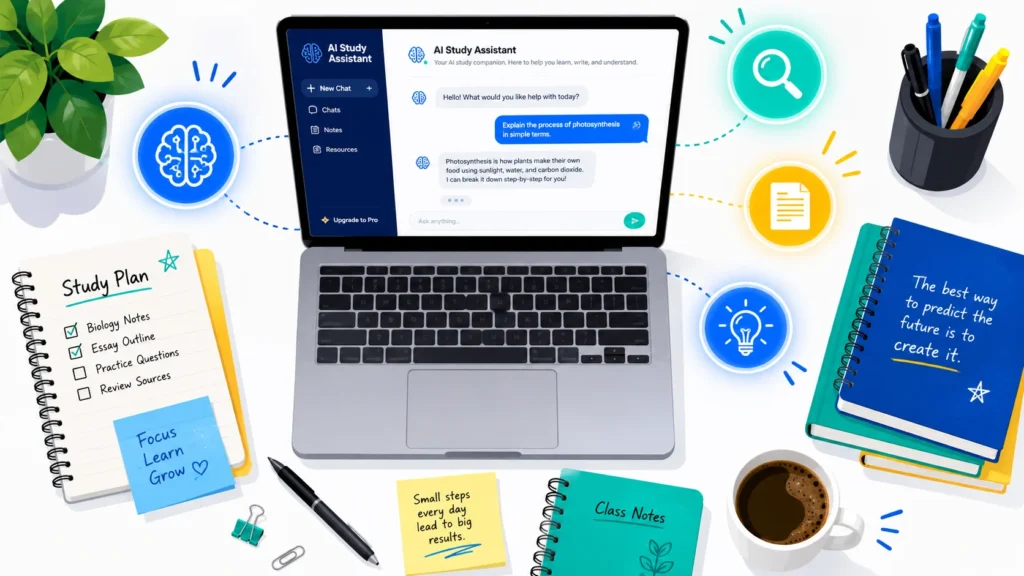
Being a student in 2026 means you have access to AI tools that would have seemed like science fiction ten years ago. You can get help understanding a complex topic, check your essay for weaknesses, create study flashcards in seconds, and solve math problems step by step — all for free.
But with dozens of AI tools out there, it can be hard to know which ones are actually worth your time.
This guide covers the best AI for students in 2026 — tools that are genuinely useful, mostly free, and won’t get you in trouble with your school.
Best AI Tools for Students in 2026 — Quick Comparison
| Tool | Best For | Free Plan | Rating |
|---|---|---|---|
| Perplexity AI | Research with sources | Yes — generous | ★★★★★ |
| Claude | Essays, writing, summaries | Yes — limited | ★★★★★ |
| ChatGPT | General study help | Yes — limited | ★★★★☆ |
| Wolfram Alpha | Math, science, calculations | Yes (basic) | ★★★★☆ |
| Quizlet AI | Flashcards, memorisation | Yes (limited) | ★★★★☆ |
| Grammarly | Grammar and writing polish | Yes (basic) | ★★★★☆ |
1. Perplexity AI — Best for Research
Perplexity AI
If you spend time researching topics for essays, papers, or class assignments, Perplexity AI is the most valuable free tool you can add to your student toolkit right now.
Unlike a regular search engine, Perplexity reads the top web sources for you and gives you a clear, summarised answer with citations. You can see exactly where every fact came from — which is important when you need to cite sources for academic work.
It also has a “Focus” mode that lets you search only academic sources, which is useful when you need peer-reviewed material for papers.
Best for: Research papers, fact-checking, understanding complex topics quickly.
Limitation: Not designed for writing full essays — use it for research, then write with Claude.
2. Claude — Best for Writing and Essays
Claude by Anthropic
Claude is the best AI writing assistant for students who want help with essays, reports, and summaries. It writes clearly, follows instructions well, and produces output that sounds natural rather than robotic.
The most useful ways to use Claude as a student are: explaining difficult concepts in simple terms, helping you outline an essay before you write it, improving your draft writing, and summarising long readings into key points.
A word of caution: using Claude to write your essay and submitting it as your own work is academic dishonesty. Use it as a thinking partner and editor — not as someone to do the work for you. That approach gets you better grades and actually helps you learn.
Best for: Essay planning, improving drafts, understanding difficult readings, summarising content.
Limitation: Daily message limits on the free plan. For heavy use, consider Claude Pro.
3. ChatGPT — Best All-Round Study Assistant
ChatGPT by OpenAI
ChatGPT is the most widely used AI tool in the world, and for good reason. As a student, you can use it to get explanations of difficult topics, generate practice questions, check your understanding of a subject, brainstorm essay ideas, and get step-by-step help with problems.
The free plan includes limited GPT-4o access, which is powerful enough for most student tasks. It also includes basic image generation through DALL-E — useful for creating visual aids or presentation graphics.
Best for: General study help, explaining topics, practice questions, brainstorming.
Limitation: Can sometimes give confident but incorrect answers. Always verify important facts.
4. Wolfram Alpha — Best for Maths and Science
Wolfram Alpha
Wolfram Alpha has been around for years and is still the best tool for students who need help with maths, physics, chemistry, and other technical subjects. It doesn’t just give you the answer — it shows you every step of how it got there.
Type in a maths problem and Wolfram Alpha will solve it, graph it, and explain the working. For science questions, it can calculate values, convert units, and pull up data. It’s genuinely different from AI chatbots because it’s built on a vast database of verified scientific and mathematical knowledge.
Best for: Maths homework, physics problems, chemistry calculations, step-by-step working.
Limitation: Step-by-step solutions require a paid Pro plan ($5/month for students).
5. Quizlet AI — Best for Studying and Memorisation
Quizlet
Quizlet has long been the go-to flashcard tool for students, and its AI features have made it even more useful. You can paste in your notes or a topic name, and Quizlet will automatically generate a set of flashcards, practice tests, and study games.
For memorisation-heavy subjects — history dates, biology terms, vocabulary, legal definitions — this kind of AI-generated study material saves hours of manual card creation.
Best for: Memorisation, vocabulary, revision before exams, any subject with lots of terms to learn.
Limitation: AI-powered features like auto-generated flashcards are limited on the free plan.
6. Grammarly — Best for Polishing Your Writing
Grammarly
Before you submit any essay or report, run it through Grammarly. The free plan catches grammar mistakes, unclear sentences, and punctuation errors. The paid plan adds tone suggestions, style improvements, and a plagiarism checker.
Grammarly works as a browser extension, so it runs in the background while you write in Google Docs or any web-based text editor. It’s one of those tools that becomes invisible once you install it — you just get better writing without thinking about it.
Best for: Fixing grammar, improving clarity, polishing final drafts before submission.
Limitation: Deeper writing improvement features require the paid plan.
How to Use AI Responsibly as a Student
Here’s how to get the most from AI without crossing any lines:
- Use AI to understand, not to copy. Ask it to explain a concept you don’t understand. Then write about it in your own words.
- Use it to improve your drafts. Write your own essay first, then ask Claude or Grammarly to suggest improvements. The final work is still yours.
- Use it for research, not answers. Perplexity is great for finding sources. Your job is to read those sources and form your own argument.
- Always verify AI-generated facts. AI tools can make mistakes. For any important fact in a paper, trace it back to the original source.
What is the best free AI tool for students in 2026?
Perplexity AI is the best free tool for research because it cites its sources. Claude is the best for essay writing and understanding complex topics. ChatGPT is the most versatile for general study help. All three have free plans that are good enough for regular student use.
Can students use AI for homework?
It depends on your school’s policy. Many schools allow AI for research, brainstorming, and editing but not for generating the actual content of graded work. Always check your institution’s guidelines before using AI on any assignment.
Is using AI cheating?
Using AI to write your essay and submitting it as your own work is generally considered academic dishonesty. Using AI as a research tool, to understand difficult topics, or to improve your own writing is increasingly accepted — but rules vary by school. When in doubt, ask your teacher or professor.
What AI tool is best for writing essays?
Claude is widely regarded as the best AI tool for writing in 2026. It follows instructions carefully, produces natural-sounding text, and handles long-form content well. Use it to help you plan, outline, and improve your essays — not to write them for you from scratch.
Is there a free AI tool for maths?
Yes. Wolfram Alpha has a free plan that solves maths problems and shows basic working. ChatGPT and Claude can also walk you through maths step by step. For detailed, verified step-by-step solutions, Wolfram Alpha Pro ($5/month for students) is the most reliable option.
Final Thoughts
The best AI tools for students in 2026 don’t do your studying for you — they help you study better. Use Perplexity to find reliable information fast. Use Claude to understand difficult material and improve your writing. Use Wolfram Alpha for anything involving numbers. Use Quizlet to memorise faster.
All of these tools are free or very low cost. There’s no reason not to add them to your study routine today. The students who learn to use AI well right now will have a real advantage — not just in school, but in every job that follows.


