

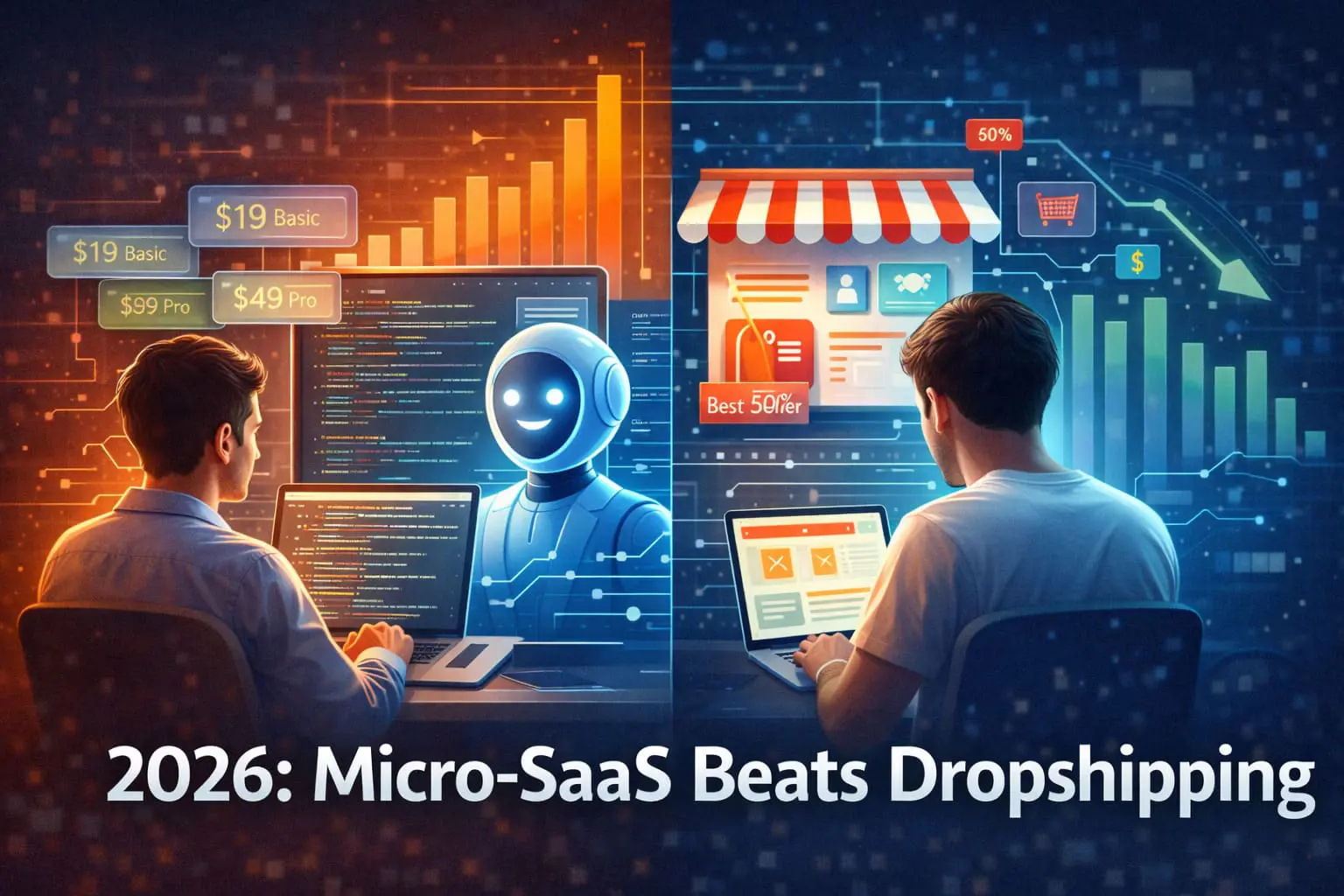


The 2026 Side Hustle Shift: Why “Micro-SaaS” is Replacing Standard Dropshipping

For nearly a decade, dropshipping was hailed as the ultimate “get-rich-quick” gateway for digital entrepreneurs. The premise was deceptively simple: find a viral product on a Chinese marketplace, spin up a Shopify store, and arbitrage traffic from Facebook or TikTok.
However, as we move through 2026, that “low-barrier” entry has become a “high-barrier” trap. Between rising customer acquisition costs (CAC), the aggressive crackdown on “AI-generated” low-quality stores, and the transparency of price-tracking AI tools, the traditional dropshipping model is facing a systemic collapse.
What this really means is that the “Smart Money” has pivoted. The most successful independent creators and developers are now building Micro-SaaS—small, focused software solutions that solve one specific problem for a niche audience. Here is the deep dive into why this shift is happening and how you can position yourself to win.
1. The Death of the Middleman Margin
In dropshipping, you are a middleman. You don’t own the supply chain, you don’t own the brand, and you certainly don’t own the shipping experience. In 2026, the consumer is more skeptical than ever. With a single click, a buyer’s AI browser assistant can find the original manufacturer and show them the 400% markup you’ve added.
Micro-SaaS solves this by offering original value. When you build a software tool—whether it’s a Chrome extension that automates LinkedIn outreach for real estate agents or a custom API that connects local inventory to WhatsApp—you own the intellectual property.
- The Barrier to Entry: It’s higher than dropshipping, but that’s your Moat. In 2026, if a business is easy to start, it’s almost impossible to keep profitable.
- The Trust Factor: Software is seen as a “Utility,” whereas dropshipping is often perceived as a “Commodity.” People pay for utilities; they bargain-hunt for commodities.
2. Recurring Revenue: The “Subscription” Floor
The biggest psychological and financial drain of dropshipping is the “Reset to Zero.” Every morning on the first of the month, your income is $0. You have to hunt for new customers, fight rising ad bids, and pray your creative doesn’t get “fatigued.”
Micro-SaaS operates on the SaaS (Software as a Service) model.
- Predictability: If you have 100 users paying $15 a month, you have a $1,500/month “floor.” You aren’t hunting; you are nurturing.
- Valuation: In 2026, an e-commerce store with $10k in monthly profit might sell for a 2x multiple. A Micro-SaaS with $10k in monthly recurring revenue (MRR) can easily command a 4x to 6x multiple on platforms like Acquire.com.
Read More: Private Space Android: How to Hide Sensitive Apps Securely
3. The “No-Code” and “AI-Agent” Explosion
The number one excuse for not starting a software business used to be: “I don’t know how to code.” In 2026, that excuse is officially dead.
The rise of Natural Language Programming and Agentic AI means that if you can describe a logic flow, you can build a Micro-SaaS. Tools like FlutterFlow and Bubble have evolved into “Pro-Code” platforms that handle complex database management and API integrations with drag-and-drop simplicity.
Expert Take: We are seeing a trend where non-technical founders use AI to write the “logic” of an app and no-code tools to build the “interface.” This allows you to launch an MVP (Minimum Viable Product) in a weekend—roughly the same time it takes to set up a high-quality Shopify store.
4. Why Google and AI Search Engines Love Micro-SaaS
From an SEO perspective, Micro-SaaS is a “Topical Authority” goldmine. Google’s latest updates reward High Utility Content.
When you host a software tool on your site (like a free tax calculator for freelancers or a site-speed auditor), your user metrics look like this:
- High Dwell Time: Users stay on the page to use the tool.
- Return Visitors: Users bookmark the page to use the tool again.
- Natural Backlinks: Other blogs link to your tool as a resource.
Dropshipping sites, by contrast, have high bounce rates and low return-visitor counts. By building a Micro-SaaS, you are essentially building an SEO Magnet that grows your domain authority automatically.
5. Case Study: The “Niche” Integration Strategy
Let’s look at a real-world 2026 scenario. Instead of trying to build the next “Slack,” smart entrepreneurs are building “Slack Add-ons.”
One founder noticed that small law firms struggled to track billable hours inside their messaging apps. They built a simple integration that triggers a timer via a slash command.
- Development Cost: $500 (using a no-code builder).
- Users: 200 law firms.
- Price: $29/month.
- Outcome: $5,800/month in near-passive income with a churn rate of less than 2%.
6. How to Start the Shift Today (The 30-Day Plan)
What this really means is that you need to stop looking for “products to sell” and start looking for “friction to remove.”
Week 1: Problem Hunting
Don’t look for a “big idea.” Look for a “Micro-Problem.” Ask yourself: what task in my daily work (SEO, Development, Marketing) takes me 15 minutes but should take 30 seconds?
Week 2: The MVP Build
Use an AI agent to draft the logic and a no-code tool to build the interface. Focus on one feature. If your tool does ten things poorly, it will fail. If it does one thing perfectly, it will scale.
Week 3: Beta Testing & Feedback
Don’t run ads. Post your tool in a specialized community (Reddit, IndieHackers, or niche LinkedIn groups). Ask for feedback, not for sales.
Week 4: The “Freemium” Launch
Launch with a free tier to build your user base. Once you have 100 active users, introduce a “Pro” tier for $9/month. Congratulations—you now have a scalable software asset.
The Final Verdict: Experience Over Hype
At the end of the day, dropshipping is a race to the bottom on price. Micro-SaaS is a race to the top on value. As a digital agency or a developer, your goal shouldn’t be to move boxes; it should be to build systems. In 2026, the code you write (or generate) is the most valuable real estate you can own.
