
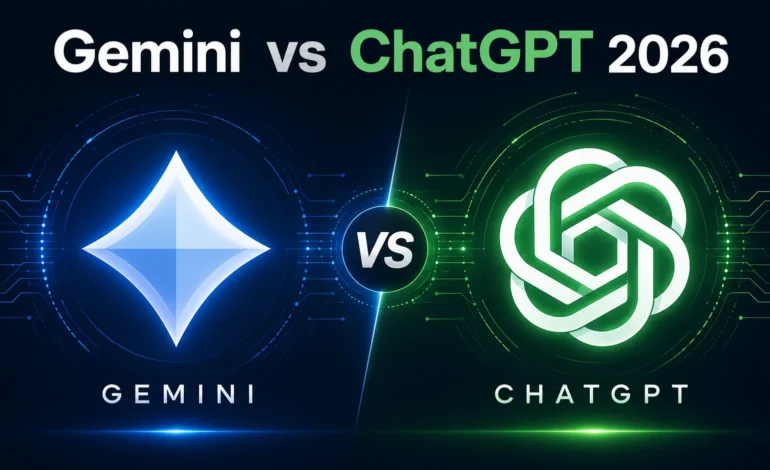

Google Gemini and ChatGPT are two of the biggest AI tools in the world right now. Both are powerful. Both have free plans. And both keep getting better every few months.
But they’re built differently — and that means one of them is probably a much better fit for the way you work.
In this Gemini vs ChatGPT 2026 comparison, we break down the real differences across writing, research, image generation, Google integration, and price. By the end, you’ll know exactly which one to use.
Gemini vs ChatGPT 2026: Side-by-Side
| Feature | Google Gemini | ChatGPT (OpenAI) |
|---|---|---|
| Made By | Google DeepMind | OpenAI |
| Free Plan | Yes — generous limits | Yes — limited GPT-4o access |
| Paid Plan | $20/month (Google One AI Premium) | $20/month (ChatGPT Plus) |
| Image Generation | Yes (Imagen) | Yes (DALL-E) |
| Web Search | Yes — powered by Google Search | Yes |
| Google Workspace Integration | Yes — Gmail, Docs, Drive, YouTube | No |
| Plugin / Extensions | Google apps + some third-party | Large plugin library |
| Monthly Active Users | 400 million+ | 900 million+ weekly |
Writing Quality: ChatGPT Has a Slight Edge
Both tools can write well. But there are noticeable differences when you push them on longer, more nuanced writing tasks.
ChatGPT tends to produce writing that feels more polished and varied in sentence structure. It’s been trained on a huge range of writing styles, and that shows. Give it a long article prompt and it usually delivers a solid first draft.
Gemini is good, but it can sometimes feel a little safe and bland on creative tasks. Where it really pulls its weight is factual writing — summaries, structured reports, and anything that benefits from being connected to Google’s real-time search data.
For pure writing quality, ChatGPT edges ahead. For factual writing with up-to-date information baked in, Gemini is hard to beat.
Research and Web Search: Gemini Wins Here
This is where Gemini has a real advantage. Its web search is powered by Google — the world’s most powerful search engine. When you ask Gemini about something current, it pulls from Google’s index in real time. The results are accurate, fresh, and well-cited.
ChatGPT also has web search, but it uses Bing. It’s good, but not quite at the same level as Google’s search infrastructure for finding the most current, authoritative information quickly.
If your work involves a lot of research — staying up to date on industry news, fact-checking, pulling together current data — Gemini’s Google-backed search gives it a clear lead.
Google Integration: Gemini Wins by a Mile
This is Gemini’s biggest advantage and there’s really no contest here. If you use Gmail, Google Docs, Google Drive, Google Sheets, or YouTube regularly, Gemini integrates with all of them.
You can ask Gemini to summarize your emails, draft a reply, find a document in your Drive, or pull data from a spreadsheet — all without leaving Google’s apps. That kind of deep integration saves a serious amount of time if you’re already in the Google ecosystem.
ChatGPT doesn’t connect to Google’s apps. It has a plugin library that connects to many third-party tools, but if Google Workspace is your daily driver, Gemini is simply the more practical choice.
Image Generation: Both Are Good, ChatGPT Is More Accessible
Both Gemini and ChatGPT can generate images from text prompts. Gemini uses Google’s Imagen model. ChatGPT uses DALL-E from OpenAI.
The image quality from both is strong in 2026. Imagen tends to produce images that look clean and realistic. DALL-E is better at stylistic and creative prompts — illustrations, art styles, concept images.
On the free plan, ChatGPT includes some image generation. Gemini’s image generation is available on both free and paid plans. Neither puts up a huge barrier on the free tier, so this one is roughly a tie — with the edge going to whichever style fits your needs.
Pricing: Both Cost the Same, Different Value
| Plan | Gemini | ChatGPT |
|---|---|---|
| Free | Gemini 2.0 Flash — generous daily use | GPT-4o — limited daily use |
| Paid ($20/month) | Google One AI Premium — Gemini Advanced + Workspace features | ChatGPT Plus — GPT-4o priority + DALL-E + plugins |
| Best Value For | Google Workspace users | General users, plugin power users |
Both cost $20 per month. The difference is in what you get for that price. Google One AI Premium is excellent value if you already pay for Google One storage — it bundles AI upgrades with your existing subscription. ChatGPT Plus gives you the best version of ChatGPT plus image generation and a large plugin ecosystem.
Which Should You Choose?
Choose Gemini if: You use Gmail, Google Docs, Drive, or Sheets daily. The integration alone is worth it. Gemini also has the more generous free plan, so it’s a great starting point even if you’re not ready to pay.
Choose ChatGPT if: You want the most versatile all-in-one tool. Its plugin library, image generation, and broad writing ability make it the better general-purpose choice. It’s also the tool most third-party apps and services support.
Use both if: They serve different purposes. Many people use Gemini for anything Google-related and ChatGPT for standalone writing and image tasks. Both have free plans, so there’s no cost to running both.
And if you haven’t tried Claude yet, it’s worth adding to your toolkit for deep writing tasks — see our best free AI tools roundup for a full look at all your options.
Is Gemini better than ChatGPT in 2026?
It depends on your needs. Gemini is better for Google Workspace integration and real-time research via Google Search. ChatGPT is better as an all-round tool with stronger plugin support and writing versatility. Neither is objectively “better” — the right choice depends on how you work.
Can I use Gemini for free?
Yes. Gemini has one of the most generous free plans among major AI tools in 2026. You get access to Gemini 2.0 Flash with daily usage that’s more than enough for most casual users. No credit card required to sign up.
Does Gemini work with Gmail and Google Docs?
Yes. Gemini integrates directly with Gmail, Google Docs, Drive, Sheets, and other Google Workspace apps. This is one of its biggest advantages over ChatGPT, which doesn’t connect to Google’s apps.
Which is better for image generation — Gemini or ChatGPT?
Both are capable. Gemini uses Google’s Imagen model, which is strong for realistic images. ChatGPT uses DALL-E, which handles creative and stylistic prompts well. Both include image generation on their free plans. Try both to see which style suits you.
Is Gemini smarter than ChatGPT?
“Smarter” is hard to define for AI. On research tasks powered by Google Search, Gemini has an edge. On creative writing and complex reasoning tasks, ChatGPT is often stronger. Most benchmarks in 2026 show the two models performing at a similar overall level.
Final Thoughts
Gemini vs ChatGPT isn’t really a fight with a clear winner. They’re built for different things, and both do their job well.
If you’re a Google person, Gemini is the obvious choice. The integration with your existing tools is seamless, the free plan is generous, and the search quality is excellent.
If you want a flexible, standalone AI tool you can use for anything — writing, research, image creation, coding, plugins — ChatGPT is still the market leader for good reason.
The smartest move is to try both on their free plans. You’ll figure out quickly which one fits your workflow.