



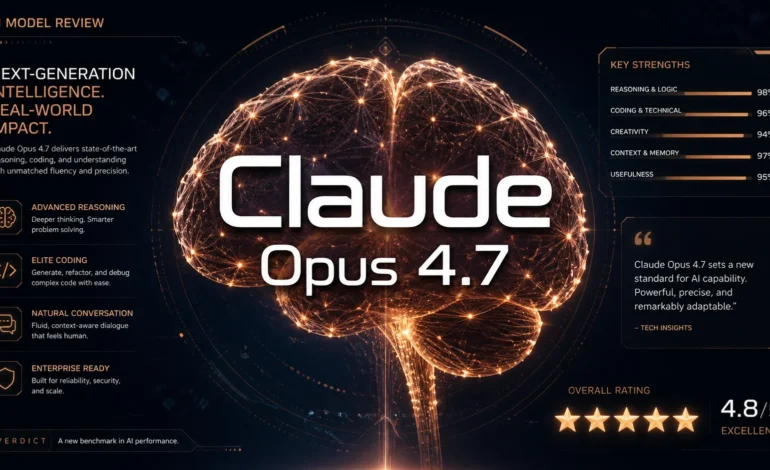

Anthropic released Claude Opus 4.7 on April 16, 2026 — and it’s a meaningful step forward. If you’ve been using Claude for work, writing, or coding, this update is worth paying attention to. If you’re new to Claude, this is a great time to start.
This Claude Opus 4.7 review covers everything you need to know: what’s actually new, where it performs best, who should upgrade, and whether it’s worth the cost.
What Is Claude Opus 4.7?
Claude Opus 4.7 is the most capable model in Anthropic’s current lineup. Anthropic makes the Claude family of AI models, and the “Opus” tier has always been their top offering — designed for the most demanding tasks.
The previous version, Claude Opus 4.6, was already well-regarded. Version 4.7 builds on that foundation with improvements focused on one specific area: agentic coding. That’s a fancy way of saying it’s now much better at handling long, multi-step coding projects without losing track of what it’s doing.
Beyond coding, it also shows improvements in reasoning, instruction-following, and document analysis.
What’s New in Claude Opus 4.7?
Step-Change Improvement in Agentic Coding
This is the headline update. Anthropic describes Opus 4.7 as a “step-change improvement” over 4.6 for agentic coding. In plain terms: if you ask it to build something complex — a multi-file app, a data pipeline, a set of interconnected functions — it now handles that without breaking down in the middle of the task.
Earlier AI models (including older Claude versions) would often lose context or make contradictory decisions when a coding task got complicated. Opus 4.7 is measurably better at staying on track.
Better Instruction Following
One of Claude’s strengths has always been following detailed instructions carefully. Opus 4.7 improves on this. If you give it a long, specific prompt with multiple conditions, it does a better job of honoring all of them — rather than focusing on the first few and ignoring the rest.
For writers who use Claude as a writing assistant, this is a noticeable improvement. Give it a style guide, a tone preference, and a word limit, and it’s more likely to hit all three.
Stronger Reasoning on Complex Tasks
Opus 4.7 handles multi-step reasoning problems more reliably. This matters for tasks like research analysis, financial modeling, legal document review, and any situation where the AI needs to hold multiple facts in mind and draw a well-supported conclusion.
Claude Opus 4.7 Performance: Where It Excels
| Task Type | Performance | Notes |
|---|---|---|
| Complex Coding Projects | ★★★★★ Excellent | Best improvement vs 4.6 |
| Long-Form Writing | ★★★★★ Excellent | Natural tone, strong structure |
| Document Analysis | ★★★★★ Excellent | 200K token context window |
| Research & Reasoning | ★★★★☆ Very Good | Careful, rarely hallucinates |
| Quick Chat / Q&A | ★★★★☆ Very Good | Sonnet 4.6 is faster for this |
| Image Generation | ✗ Not Available | Claude doesn’t generate images |
Claude Opus 4.7 Pricing
Here’s how the pricing works for Claude in 2026:
| Plan | Price | Model Access |
|---|---|---|
| Free | $0 | Claude Sonnet 4.6 (limited usage) |
| Claude Pro | $20/month | Claude Opus 4.7 + Sonnet 4.6 (priority access) |
| API Access | Pay per token | All models — for developers |
If you’re already a Claude Pro subscriber, you already have access to Opus 4.7 — no action needed. If you’re on the free plan, you can still use Claude Sonnet 4.6 for free, which is a capable model in its own right. Opus 4.7 is the Pro-tier upgrade.
Who Should Use Claude Opus 4.7?
Developers and coders will see the biggest benefit. The agentic coding improvements are real and meaningful, especially for anyone working on multi-file or multi-step projects.
Writers and content creators will appreciate the improved instruction-following. If you use Claude to draft long articles, reports, or scripts, Opus 4.7 is noticeably more reliable at staying within the parameters you set.
Researchers and analysts benefit from the larger context window and stronger reasoning. You can feed it an entire report, ask it to compare findings across sections, and trust the output more than you could with earlier models.
Casual users doing simple daily tasks may not notice a huge difference from Sonnet 4.6. The free plan is still a great starting point for lighter use.
Claude Opus 4.7 is a strong, meaningful upgrade — especially for anyone doing serious coding or working with complex documents. The only thing it’s missing compared to some competitors is built-in image generation.
What is Claude Opus 4.7?
Claude Opus 4.7 is Anthropic’s most capable AI model as of April 2026. It’s the top tier of the Claude model family and is especially strong at complex coding, long-form writing, and detailed reasoning tasks.
How is Claude Opus 4.7 different from Opus 4.6?
The biggest improvement is in agentic coding — Opus 4.7 is significantly better at handling long, multi-step coding projects without losing context. It also has improved instruction-following and reasoning on complex tasks.
Can I use Claude Opus 4.7 for free?
No — Opus 4.7 is only available on the Claude Pro plan ($20/month). The free plan gives you access to Claude Sonnet 4.6, which is still a capable model for most everyday tasks.
Is Claude Opus 4.7 better than GPT-4o?
Both are excellent models at the top of the AI industry in 2026. Claude Opus 4.7 tends to be stronger for long-form writing and complex multi-step coding. GPT-4o has the advantage of built-in image generation and a wider plugin ecosystem. The better choice depends on your workflow.
When was Claude Opus 4.7 released?
Claude Opus 4.7 was released by Anthropic on April 16, 2026.
Final Thoughts
Claude Opus 4.7 is a genuine upgrade, not just a version bump. The improvements to agentic coding are the standout feature, and the gains in instruction-following make it more reliable for professional use.
If your work involves writing, research, or coding — and you’re serious about using AI as a real productivity tool — Claude Opus 4.7 is one of the best options available today. The $20/month Pro plan gives you full access, and the free plan with Sonnet 4.6 is still a solid place to start.
Anthropic keeps improving Claude at a fast pace. If Opus 4.7 is this good, the next release will be worth watching closely.